
Tampere Biennale: Secret Flowers
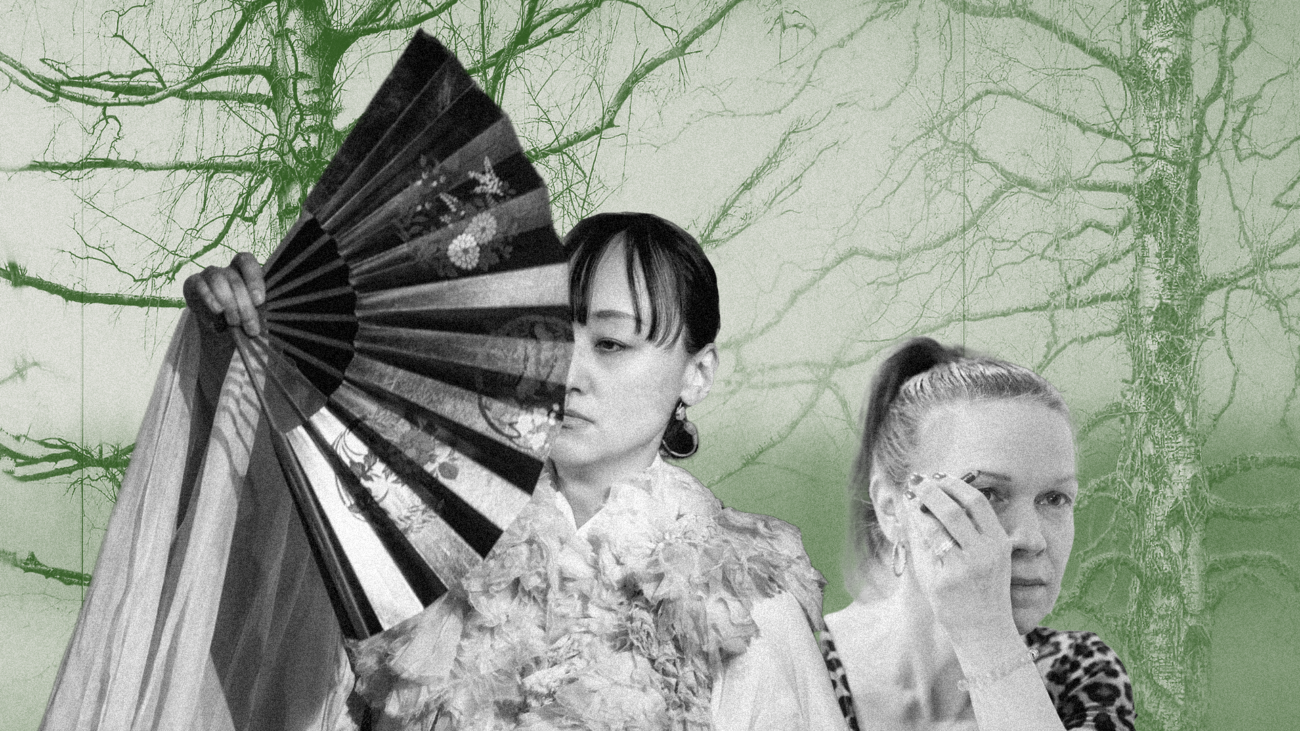
The unique contemporary music theatre evening Secret Flowers is built around classical Japanese Noh theatre.
Information
Tickets €35
Pensioners €30
Children and young people (under 16) and students €20
Please note! Following the Secret Flowers performance, at 5.30 pm, a panel discussion will be held in the Small Auditorium, where Tampere Hall’s Artistic Director Suvi Leinonen will interview the production’s artistic team.
The panel features librettist Selja Ahava, Noh singer Ryoko Aoki, director-dramaturge Aleksi Barrière, composer Juha T. Koskinen, and actress Petriikka Pohjanheimo. The discussion is held partly in English and Finnish.
Intercultural dialogue through Japanese Noh theatre
The unique contemporary music theatre evening Secret Flowers is built around classical Japanese Noh theatre. This sequence of four contemporary works is a dive into the expressive world of Noh: the oldest still-active interdisciplinary tradition, centred on both the darker and brighter mysteries of humanity.
The evening is the creation of contemporary music theatre specialist Aleksi Barrière (b. 1989), who serves as both the dramaturg and director. Representing both tradition and its ongoing reinvention, the internationally praised Noh vocalist Ryoko Aoki will appear in Finland for the first time. The music will be performed by the Avanti! Chamber Orchestra, renowned for their high-quality and boundary-crossing concert productions.
Composer Toshio Hosokawa (b. 1955) brings the fragile aesthetic of Noh into the Western instrumental world in his string quartet Silent Flowers (1998). Noriko Baba (b. 1972), in turn, gives Noh singing a new context in her work Hagoromo Suite (2017), receiving its Finnish premiere.
The programme begins and concludes with the two-part world premiere by composer Juha T. Koskinen (b. 1972). The libretto for Prologue (to all stories) is by Aleksi Barrière, and the chamber drama The Woman on the Sixth Street is based on a libretto by writer Selja Ahava (b. 1974).
In The Woman on the Sixth Street, Lady Rokujō, famous from her appearance in various Noh plays where she is abandoned by her lover, appears both in her original form and as a woman of our own time. These mirrored versions of the role are performed by Noh singer Ryoko Aoki and actress Petriikka Pohjanheimo.
Concert duration: 1 hour 15 minutes. No intermission.
Performers:
Ryoko Aoki, Noh singing
Petriikka Pohjanheimo, actress
Avanti! Chamber Orchestra:
Rémi Cornus, violin
Margaux Rouzeau, violin
Tuula Riisalo, viola
Smaranda Iftime, cello
Tuija-Maija Nurminen, percussion
Artistic Team:
Aleksi Barrière, direction and dramaturgy
Étienne Exbrayat, stage and lighting design
Yuichiro Sato, paintings
Produced by: Tampere Hall, Kimaira ry, La Chambre aux échos
The team of Secret Flowers thanks the multimedia artist Jean-Baptiste Barrière and the designer Lucia Schmidt, who have supported this production with their know-how in its final execution phase, almost voluntarily.
The event is part of the Tampere Biennale programme, taking place from 15 to 19 April 2026. This year marks the 40th anniversary of the festival, founded by composer Usko Meriläinen as a celebration of Finnish contemporary music.
Secret Flowers has received support from the Finnish Cultural Foundation – Mirjam and Hans Helin Fund (project grant), the Finnish Arts and Culture Agency (project grant and Juha T. Koskinen’s one-year artist grant), the Finnish Composers’ Society’s Sibelius Fund (Pegasos grant for Selja Ahava’s writing work) and the Finnish Music Foundation (Petriikka Pohjanheimo’s work grant).
Produced by: Tampere Hall, in collaboration with Tampere Biennale
Programme & Introductions
Juha T. Koskinen: Prologue (to all stories) (libretto: Aleksi Barrière) (2026, world premiere)
“The nō play Hagoromo tells the story of a fisherman who finds the feather mantle of a heavenly being: the fate of the ‘bird maiden’ now lies in his hands, for without the cloak, she cannot fly back to heaven. The story has become a Japanese classic, but there are also numerous versions of it in other cultures. Why are similar stories told around the world, and why these stories? What is the most important aspect in them, the universal core or the local variations? As we retell this ancient tale, we are confronted with a mystery common to all stories.
The music of Prologue (to all stories) is closely linked to the final scene of The Woman on the Sixth Street. This endows the music of the Secret Flowers program with a cyclical form. The play Nonomiya – in which seasonal cycles and their relationship to those of human life play an important role – is a connecting element. Together with the prologue’s writer and director, Aleksi Barrière, we developed a compositional method based on the timbres and rhythmic patterns of percussion instruments, which interact with the unfolding of the story told by the actor. From short rhythmic cells, my version of the “Suruga dance” gradually emerges, building into a sounding climax the urge for transcendence contained in the story of the ‘hagoromo’.” (Juha T. Koskinen)
Noriko Baba: Hagoromo Suite (2017, Finnish premiere)
Traditionally women were allowed to study utai, nō singing, but not to perform on the theatre stage, which was reserved to men. There was then more freedom in the recital format, in which social and artistic conventions are both approached more loosely. Ryoko Aoki invited composer Noriko Baba to explore this freedom by creating a chamber work based on the classic play Hagoromo, combining the original singing line with new instrumentation.
“I aimed to compose a Nōpera, un mixture of nō and European music. Hagoromo Suite is based on four excerpts of the famous play. I have tried to convey the soundscape of the seaside, the rustle of wind in the pine trees, the softness of the feather mantle…” (Noriko Baba)
Toshio Hosokawa: Silent Flowers (1998)
“Flowers are a rich metaphor. If flowers would be there forever, they would no longer be beautiful. Since they wither, they show us how beautiful and precious life is. In his aesthetics, the playwright and nō theoretician Zeami calls the art of the outstanding actor the ‘flower.’ This corresponds to our Buddhist way of thinking: transience is beautiful.
It is the same with music. It sounds but always disappears quickly. Music is beautiful because it always lives in its own time. It remains in the listener’s heart, but it is fleeting. It’s the same with nō – an event is unique and always followed by death, silence, emptiness, void, and this is why everything that we do has to be beautiful.
In ikebana, the Japanese art of flower arrangement, we cut the flowers, which will lead to their death. We know that they will stay with us for only one or two days, but this is the reason why we think the flower is beautiful. You know our Japanese cherry blossom; it only lasts five days and then fades away like the rain, so beautiful. In contrast to the art of the West, which tries to grasp the eternity and permanence of beauty, here you find beauty in the sadness of a life that withers and dies.” (Toshio Hosokawa)
Juha T. Koskinen: The Woman on the Sixth Street (libretto: Selja Ahava) (2026, world premiere)
“This work combines two different cultures and eras, Heian Japan (1000s) and contemporary Europe. The libretto consists of selected excerpts from the Japanese nō plays Nonomiya and Aoi no Ue in the original language and a new text in Finnish, commissioned from the author Ms. Selja Ahava, to be spoken by an actor.
In our new work, the nō performer and the actor present two aspects/versions of the same person, mirroring each other. My collaboration with nō singer Ryoko Aoki, which began in 2010, is the starting point for our work. Together with her, we selected excerpts from the utaibon score of nō plays are woven into the new text and music. The whole project is an ongoing dialogue with her.
The nō plays Nonomiya and Aoi no Ue are based on the novel The Tale of Genji, written over 1000 years ago by the Japanese court lady Murasaki Shikibu. The protagonist is Lady Rokujō, one of Prince Hikaru Genji’s many mistresses, whom Genji has abandoned. Out of jealousy, Rokujō unleashes a vengeful ghost (ikiryō) who persecutes Genji’s wife and other mistresses. In our new work, Selja Ahava’s text mirrors the ancient story from the perspective of our own time. In this way, these two women writers from completely different cultures and eras are in dialogue with each other in the same way that my own contemporary musical score is in dialogue with the song and dance expression of 15th-century Japanese nō theatre.” (Juha T. Koskinen)
Artists
Ryoko Aoki is the pioneer of and inspiration for a new artistic form combining utai – traditional nō recitation – with contemporary music. More than 55 works have been written for her by world-renowned composers including Peter Eötvös and Toshio Hosokawa. Singing with orchestras and performing in operas, she has worked to expand the audience for nō recitation.
She has performed in Wolfgang Rihm’s opera “The Conquest of Mexico” at the Teatro Real de Madrid as well as with orchestras including the Royal Concertgebouw Orchestra, the Orchestra of the Maggio Musicale Fiorentino, the Spanish National Orchestra, the Ensemble Intercontemporain, the Ensemble Musikfabrik and the Munich Chamber Orchestra. She has participated in music festivals including the Festival d’Automne in Paris, the Musikfest Berlin, the Bartok Festival, the Ars Musica, the Tongyeong International Music Festival and the Suntory Hall Summer Festival. She has also performed at major concert halls including the Concertgebouw, the Berlin Philharmonie, the Philharmonie de Paris, the Kölner Philharmonie and the Suntory Hall.
As part of her Contemporary Music x Noh project, Ryoko Aoki has commissioned a series of new works for nō voice. During Covid-19 pandemic, she has broadcasted the online concert HO NOH – Pray for an end to the Covid-19 as live-streaming distant session on her YouTube Channel. She released the Noh x Contemporary Music recording in 2014 and Yoru no Kotoba recording with the cellist of Ensemble Intercontemporain, Éric-Maria Couturier in 2021. Ryoko earned her BA and MA from the Department of Music at Tokyo University of the Arts (majoring in the Kanze School of nō theatre), before gaining a Ph.D. from SOAS, University of London. She was appointed a “Japan Cultural Envoy” in 2015 by the Japanese Agency for Cultural Affairs and was awarded “The Creative Tradition Prize” in 2019 by the Japan Arts Foundation.
Petriikka Pohjanheimo is a Finnish actor. Before studying acting at the Theatre Academy of Helsinki, she studied classical singing as her major at the Sibelius Academy’s Department of Music Education. Over her 30-year career, Petriikka has performed in Helsinki and across Finland, on the stages of both independent and municipal theatres. Recent highlights of her theatre work include the monologue Toukka-akka written by Selja Ahava (the Finnish National Theatre’s Touring Stage, 2023),
Brechtiä jokanaiselle written by Sirpa Kähkönen, in which Petriikka played the role of Helene Weigel (Musiikkiteatteri Kapsäkki, 2022), and Norminäytelmä written by Marjo Niemi (KokoTeatteri, 2021). Petriikka has also been involved in interdisciplinary projects, such as the radio dramas Puu – A Tree (YLE 2021) and Omppu – An Apple (ArtLab/YLE 2024), co-produced with playwright Elina Snicker, contemporary composer Riikka Talvitie, and sound designer Tuomas Skopa.
In addition to her work as an actor, Petriikka is also known as an artist whose work focuses on minority rights and the promotion of equality. These themes are central to the vocal ensemble The Friends of Dorothy, in which Petriikka performs as a singer. In recent years, the group has performed in cities such as Berlin, London, Madrid, Minneapolis, and Mexico City.
Avanti! Chamber Orchestra, based at the Cable Factory in Helsinki, has been a pioneering presence in Finland’s music scene since 1983, bringing new currents of music to the ears of listeners. Avanti regularly performs both world and Finnish premieres, produces concert productions that cross boundaries, as well as interdisciplinary collaborative projects. Each year culminates with the Summer Sounds Festival in Porvoo. Avanti seeks to open doors also to artistic and interdisciplinary dialogue that resonates within broader social contexts.
Juha T. Koskinen is an internationally active composer, whose broad output ranges from chamber operas to orchestral works and electronic soundscapes. His compositional vision is stimulated by encounters between different cultures and timeframes. He has developed a deep connection to Japan, which he visits regularly in both the capacity of a composer and of a visiting composition teacher; his work Sogni di Dante received the Takefu International Music Festival’s composition prize in 2004.
From the beginning of his career, Koskinen has had a special affinity to muisc theatre. Earthrise for actor, singer-improviser and baroque orchestra wa spremiered at the Finnish National Opera in 2024 as part of the Helsinki Early Music Festival. Ophelia/Tiefsee for actor, viola and chamber orchestra, like the previous a collaboration with writer-director Aleksi Barrière, was commissioned by Radio France and premiered at the Présences festival in Paris in 2017. It received its Finnish premiere at the Finnish National Opera within the Musica Nova Festival.
In 2017, the baroque ensemble Cornucopia commisisoned Superborea, for four baroque musicians, dancer, electronics and lighting, and was premiered at Cirko. In 2015, the monologue opera Lusia Rusintytär was performed at the Helsinki Festival. These works were preceded by the chamber opera Madame de Sade (2010) after Yukio Mishima, and the early chamber operas Velhosiskot and EUKKO commissioned and premiered by Ooppera Skaala.
Koskinen’s music has been commissioned and premiered among others by kantele player Eva Alkula, nō singer Ryoko Aoki, flutist Camilla Hoitenga, guitarist Patrik Kleemola, organ player Jan Lehtola, clarinetist Reetta Näätänen, cembalist Anna-Maaria Oramo, clarinetist Mikko Raasakka, mezzosoprano Virpi Räisänen, clarinetist Lauri Sallinen, guitarist Norio Sato, pianist Kimihiro Yasaka, koto player Nobutaka Yoshizawa, AsianArt Ensemble, La Chambre aux échos, Ensemble Cornucopia, Ensemble Court-Circuit, Ensemble H[akka], Ensemble Nomad, Ensemble Recherche, the Helsinki Chamber Choir, the Kamus quartet, the Ostrobothnian Chamber Orchestra, the Meta4 quartet, NOVOFLOT Opera Company, Ooppera Skaala, Quatuor Danel, Quatuor Diotima, the Finnish Radio Symphony Orchestra and the Finnish Baroque Orchestra (FiBO).
Koskinen studied composition at the Sibelius Academy, the Lyon Conservatory and IRCAM in Paris, with teachers such as Kalevi Aho, Anders Eliasson, Paavo Heininen, Kaija Saariaho and Philippe
Manoury. Koskinen is also a teacher, and has been a visiting professor of composition at the University of Aichi (Japan) in 2016, 2020 and 2023.
Noriko Baba was born in Niigata, Japan. She received a Masters in composition at the Tokyo University of the Arts (Geidai), and an honor prize at the Conservatoire National Supérieur de Musique de Paris in composition and orchestration, while studying acoustics, analysis and ethnomusicology. She participated in the Cursus at IRCAM.
She has been invited to participate in major contemporary music festivals, and has been played by most of the world’s leading contemporary music ensembles. She received several grants and other awards including the Prize of the NHK-Mainichi Composition competition, the Florent Schmitt Prize, the Georges Wildenstein Prize from the Académie des Beaux-Arts de l’Institut de France, the Grand Prix for International Composition of the Takefu Festival, the Akiyoshidai Music Competition, the Sacem, and been welcomed by Akademie Schloss Solitude in Stuttgart, Académie de France à Madrid (Casa de Velazquez) as a Member, Villa Kujoyama (French Ministry of Foreign Affairs), and Académie de France à Rome (Villa Medici) as a Pensionnaire.
She has also taught on several occasions at the Royaumont Foundation’s Voix Nouvelles program and at the Takefu Festival. She was composer in residence at HEMU (Haute école de musique Lausanne, Vaud Valais Fribourg) in 2024-2025 and at the Cité musicale Metz & the Metz National Orchestra in 2024-2026.
Toshio Hosokawa, Japan’s pre-eminent living composer, creates his distinctive musical language from the fascinating relationship between Western avant-garde art and traditional Japanese culture. His music is strongly connected to the aesthetic and spiritual roots of the Japanese arts (such as calligraphy), as well as to those of Japanese court music (such as Gagaku). He gives musical expression to notions of beauty rooted in transience: “We hear the individual notes and appreciate, at the same time, the process of how the notes are born and then die: a sound landscape of continual ‘becoming’ that is animated in itself.” Born in Hiroshima in 1955, Toshio Hosokawa came to Germany in 1976, where he studied composition with Isang Yun, Brian Ferneyhough, and later, Klaus Huber. Although his initial compositions drew inspiration from the Western avant-garde, he gradually built a new musical world between East and West. He first gained widespread recognition with the 2001 world premiere of his oratorio Voiceless Voice in Hiroshima.
Many of Toshio Hosokawa’s music theatre works are now part of the repertoire of major opera houses. His first opera Vision of Lear, which was received with great praise at the 1998 Munich Biennale, was followed in 2004 by Hanjo, a work staged by choreographer Anna Teresa de Keersmaeker and co-commissioned by the Brussels opera house La Monnaie and the Aix-en-Provence Festival. It has since been performed on numerous stages, most recently in 2022 as the American premiere at the Catapult Opera in New York with the Talea Ensemble and in 2023 in a further production with choreography by Sidi Larbi Cherkaoui at the Bavarian State Opera. The opera Matsukaze, like Hanjo, is based on material from Japanese nō theatre. The work, which has since been performed many times, was first staged by choreographer Sasha Waltz at La Monnaie opera house in Brussels in 2011. The monodrama The Raven for mezzo-soprano and ensemble, premiered in Brussels in 2012, was also staged in several theatrical performances.
Toshio Hosokawa has received numerous awards and prizes. He has been a member of the Academy of Fine Arts Berlin since 2001 and was a fellow of Berlin’s Institute for Advanced Study in 2006/7 and 2008/9. In 2013/14 he was composer in residence at the Netherlands Philharmonic Orchestra as well as
at the Hiroshima Symphony Orchestra from 2019 till 2021. In 2018 he received the Japan Foundation award, and in 2021 he was awarded the Goethe Medal for his services to cultural exchange between Japan and Germany. He is artistic director of the Takefu International Music Festival and artistic director of the Suntory Hall International Program for Music Composition.
Aleksi Barrière is a French-Finnish writer, director and dramaturge. He works as a versatile creator of music/theatre and is the artistic director of the French performance collective La Chambre aux échos. His work is lauded for its sharp interdisciplinarity extended to intercultural collaboration, and the creative stances of his dramaturgies, in search of the new forms that are called by new narratives.
In addition to his work as a visiting director, Barrière has developed with his collective, and in collaboration with conductor Clément Mao-Takacs, a broad range of performances where music and theatre meet in renewed ways, expanding on the available forms offered by theatre and opera. The collective’s work has included re-explorations of 20th-century classics (Berio, Cage, Feldman, Henze, Milhaud, Schönberg, Stravinsky…) as well as collaborations with living composers.
His recent work in Finland includes the music/theatre performance Between (text and staging, Finnish National Opera, 2022), The Fatzer Soldier’s Tale (text and staging, Musiikkitalo Helsinki, 2022), and a series of stagings for the Night and Aria Festival in Espoo (Curlew River, 2023; Handel’s Messiah and Peter Maxwelll Davies’ Eight Songs for a Mad King, 2024). Eathrise, an intertwining of new and baroque music written and directed by Barrière, was premiered at the Finnish National Opera in the fall of 2024.
As a librettist, Barrière has also collaborated closely with composers such as Kaija Saariaho (choral works 2005-2020, the opera Innocence in collaboration with writer Sofi Oksanen, 2021), Juha T. Koskinen (Ophelia/Tiefsee, 2017; Earthrise, 2024; *Waterfire, TBA), and Diana Syrse (Connected Identities, 2017; Circe, 2021). Outi Tarkiainen’s opera Day of Night, on a libretto by Barrière, will be premiered at Aalto-Theater Essen and Finnish National Opera in 2027. New works created together with composers Tomás Bordalejo, Sami Klemola and Lauri Supponen, among others, are in the making.
Barrière is also the French translator of poetry collections by Eeva-Liisa Manner and the writings of composer-director Heiner Goebbels, and writes regularly in outlets such as the Finnish magazine Rondo as a columnist.
Yuichiro Sato lives and works in Laukaa, Finland, since 2016. Japanese artist Yuichiro Sato draws amazingly detailed depictions of Finnish nature. Sato’s drawings, made with pencil, capture the beauty of the Finnish landscape. Sato walks and takes photographs in his nearby forests, and combined with his imagination, they form the basis for the immersive large-scale works that contain countless details. For Sato, nature is cosmic and an endless source of inspiration. Japanese traditional art has influenced Sato significantly and is the basis for his technique. What is transferred onto the paper, is not always the visible world, but also the invisible; the smell, sense of touch and sound of the forest. When gazing at the works, the viewer has a vivid sense of the silent surroundings and the life that the trees and the ecosystems of the depicted forests contain.
“I think the work I do can only be made here”, says Sato. The decaying birches in the forest near his studio attracted the artist with their special beauty. “They made me realize the power of life. Looking at the decaying trees, I came to the realization that life is not actually disappearing, but instead the phenomenon gives birth to new life in the forest. The decomposing trees contain all the traces left by the passage of time, and when approaching them you can smell the condensed air of the forest.”
Sato’s second exhibition with Makasiini Contemporary, titled “The Depth of Silence” presents new works inspired by forests, including the 8-meter-wide panoramic work of the same name, an enlarged reproduction of with is featured in the performance Secret Flowers. After a string of exhibitions in his home country Japan, he has had several solo exhibitions in Finland, including the Jyväskylä Art Museum. In addition to various private and public collections in Japan and Europe, the British Museum acquired Sato’s work last year.
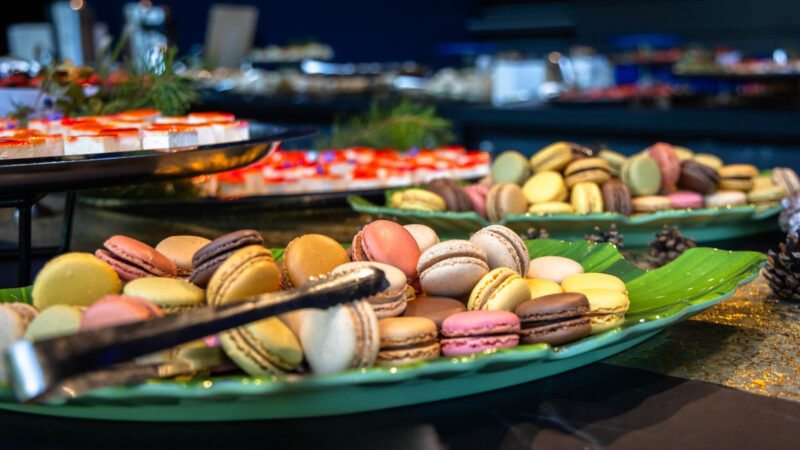
Did you know that you can pre-order refreshments for before the performance or during the interval?
Explore this season’s refreshments here:
Tampere Hall Pastry: Baked organic apple tart (L, G) – €8.00
Chocolate-Apricot Pastry (L, G) – €9.00
Lemon Tartlet (L) – €8.00
Apple Cake with Vanilla Whip (Ve) – €8.00
Salted Caramel & Nut Brownie with Marinated Raspberries (Ve, G) – €8.00
Salted Caramel Macarons, 2 pcs – €5.50
Dietary codes:
L = Lactose-free, Ve = Vegan, G = Gluten-free
Sweet and Savoury Combo: Lightly seared gravlax with a passionfruit mousse pastry (L) – €8.00
Prawn Sandwich (L, G) – €14.00
Tomato-Pesto Pastry (L, G) – €8.00
Goat Cheese Bagel (L) – €8.00
Air-Dried Ham Bagel (L) – €8.00
Carrot and Herb Tartlet (Ve, G) – €8.00
Dietary codes:
L = Lactose-free, VL = Low-lactose, Ve = Vegan, G = Gluten-free
MENU €22
(€26 when ordered on the spot)
Salmon pie and smoked sour cream L, G
Finnish flatbread, smoked reindeer and rooftop garden microgreens L
Vegetable pie and smoky oat fraîche Veg, G
Finnish flatbread, smoked tofu and rooftop garden microgreens Veg, G
***
Chocolate mud cake, marinated organic berries and rooftop honey L, G
Macaron pastry and organic edible flowers L, G
Seasonal apricot pastry Veg, G
***
Organic coffee and organic tea
Dietary codes:
L = Lactose-free, VL = Low-lactose, Ve = Vegan, G = Gluten-free
Enjoy a buffet-style selection featuring, among other delights, locally produced cheeses, cold cuts, and mouth-watering marinated treats. Special dietary requirements are accommodated based on advance notice at the time of booking. A pre-booked seat at the antipasto table served before the performance €22.90. The table is set 1.5 hours before the performance begins on the 3rd floor of Tampere Hall. There is a bar in the space where drinks can be ordered on the spot. Check whether the menu is available for the performance and come enjoy!
Secure your preferred refreshments by purchasing them in advance. Refreshments can be pre-ordered online no later than 6 p.m. on the day before the event. You can place your order via the “order refreshments” link for your chosen event.

Ask for a group offer
If your party includes 10 or more people
you can ask for a group offer:
ryhmamyynti@tampere-talo.fi
tel. 03 243 4501 (Mon to Fri from 10 am to 4 pm)
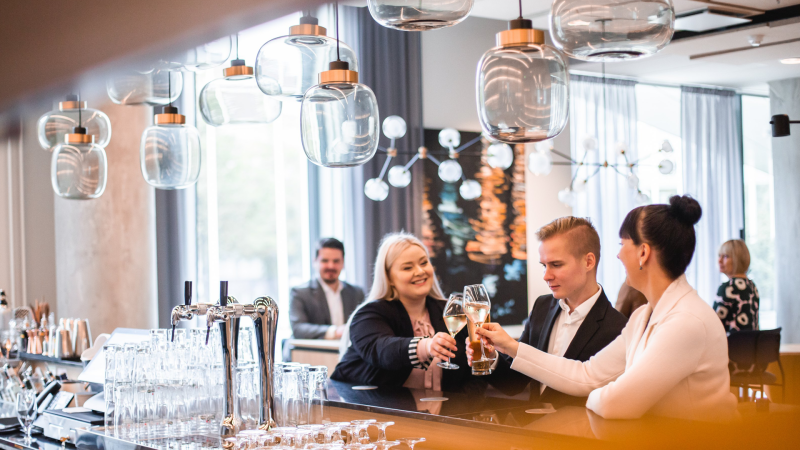
Complement your experience by staying under the same roof
The Courtyard Tampere City hotel, attached to Tampere Hall, offers the perfect experience. When you book accommodation for your visit through us, you get partner rates. Welcome to enjoy yourself!
Photo: Laura Vanzo, Visit Tampere
You might also enjoy
- Tampere Hall
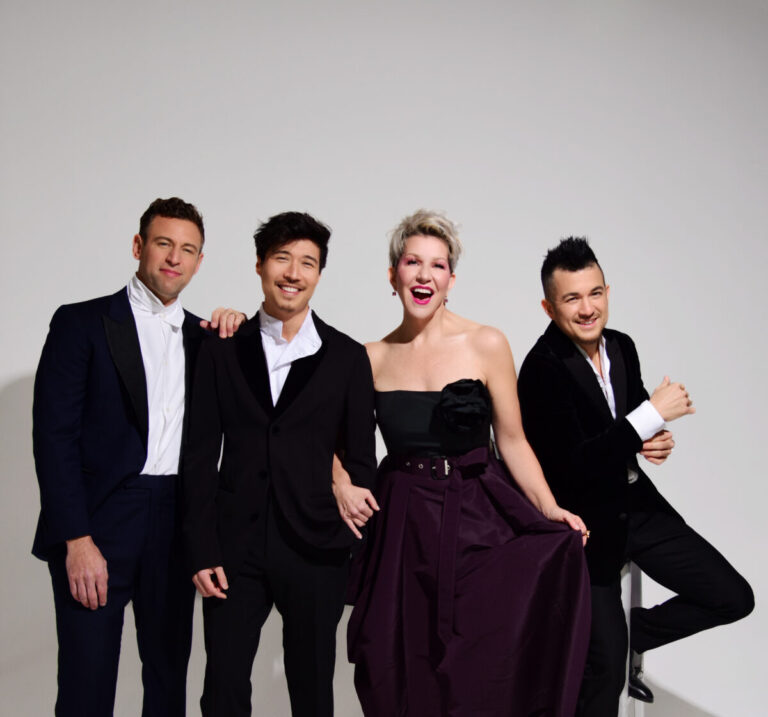
Joyce DiDonato: Emily – No Prisoner Be
World-renowned mezzo-soprano Joyce DiDonato and Time for Three trio perform Kevin Puts’ acclaimed masterpiece.

- Tampere Hall
Tchaikovsky: The Nutcracker – A Christmas Carol
The Czech National Ballet’s enchanting Christmas ballet offers a delightful experience for the whole family.
- Tampere Hall
Puccini: Turandot
Puccini’s final masterpiece to be performed for the first time at Tampere Opera!